AC Output Solid State Relay – Silent, Fast, Reliable | ZJSHUYI

Need a quiet, long-life switching solution? ZJSHUYI explains how an AC output solid state relay works and when to use one.
Article: AC Output Solid State Relay – No Moving Parts, No Headaches
If you’re tired of hearing that click-clack from mechanical relays or replacing them too often, it’s time to look at an AC output solid state relay. This little device does the same job—turning AC power on and off—but without any moving parts.
Sounds simple, right? But there’s more to it. Let’s walk through what makes this relay different, where it shines, and a few things you should watch out for.
How It Actually Works
Inside the relay, you won’t find springs, armatures, or contacts. Instead, you get a clever setup: a small LED on the input side and a triac or two SCRs on the output side. When you apply a small control voltage—say 3 to 32 volts DC—the LED lights up. That light hits a photosensitive device, which then turns on the triac.
The triac handles the high-power AC load, whether it’s a heater, a motor, or a bank of lights.
Because nothing physically moves, switching happens in milliseconds. Plus, there’s no spark, no bounce, and no contact wear. So if you need fast, silent, and reliable switching, ZJSHUYI builds relays exactly for these jobs.
Two Flavors: Zero-Crossing vs. Random Turn-On
Here’s where people get confused. Not all relays switch the same way.
- Zero-crossing type only turns on when the AC voltage crosses zero volts. That’s great for resistive loads like heaters or ovens. It reduces electrical noise and surge current.
- Random turn-on type turns on right when you send the signal. That works better for inductive loads like small motors or transformers, or for phase control like light dimming.
So before you pick one, know your load. Heater? Go zero-crossing. Motor or dimmer? Go random. ZJSHUYI offers both types, so you get exactly what your application needs.

The Real Benefits You’ll Notice
Switching from a mechanical relay to a solid state relay gives you three clear advantages.
First, silence. No clicking. That matters in medical devices, recording studios, or any quiet environment.
Second, long life. Mechanical relays wear out after 100,000 to 1 million cycles. A solid state relay can handle tens of millions of cycles. No contacts to pit or weld shut.
Third, fast switching. We’re talking microsecond response times. That’s essential for temperature control systems where you need to pulse heaters quickly.
At ZJSHUYI, we’ve seen customers cut maintenance costs significantly just by making this switch on high-cycle applications.
One Thing You Can’t Ignore: Heat
Here’s the honest truth. A solid state relay runs hot under heavy load. It always drops about 0.8 to 1.5 volts across its output. Multiply that by 10 amps, and you get 10 to 15 watts of heat.
That heat has to go somewhere.
If you run more than 5 to 10 amps, you’ll need a heatsink. At 20 amps or above, add forced air cooling. Skip the heatsink, and the relay overheats, shortens its life, or triggers internal thermal shutdown. So when you design your panel, treat heat management as part of the relay selection.
When to Skip This Relay
Great device, but not perfect for everything.
Avoid it for very small loads (less than 50 mA). The leakage current—usually 1 to 10 mA—might keep your load weakly powered. That’s annoying for LEDs or small coils.
Also, skip it for high-frequency DC switching. That’s what DC output solid state relays are for. And for heavy motor reversing? Use a mechanical contactor with proper arc suppression.
Final Takeaway
An AC output solid state relay gives you fast, quiet, and long-lasting AC switching. Pick the right turn-on type, manage the heat with a proper heatsink, and it’ll run for years.
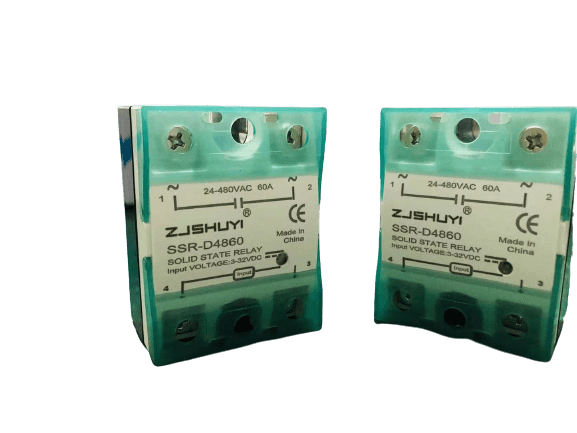
ZJSHUYI offers a full range of AC output solid state relays from 10A to 100A, with both zero-crossing and random options. Not sure which fits your heater or motor? Just ask. We’ll help you match the relay to the job. #AC Output Solid State Relay # Solid State Relay